Fundraising. We all know what it is – raising money to help a ‘good cause’, be that local legends or sector specialists.
But, philanthropy? Do we truly understand what that is?
If you are in the not-for-profit sector and you don’t really understand philanthropy (and why it matters), you are not alone.
You are also missing the most essential element for drawing significant, long-term support to your purpose.
Operating with a philanthropic mindset is transformational, both for your organisation and the people who believe in you. Many people are looking for a meaningful human experience that enriches their life, aligns with their values and enables them to be part of something beyond themselves alone. That experience can be your organisation and its purpose. When your purpose is clear and compelling, and donors see themselves as an intrinsic part of its journey, gifting money becomes more than a donation – it becomes an opportunity for connection, joy and meaningful impact.
This mutuality and its transformational potential is at the heart of philanthropy, and fundraising – as described by one of the fundraising profession’s most influential thinkers, Hank Rosso, is really just its servant.
The fundraising treadmill
Over the last two decades, New Zealand’s charitable sector has worked hard to professionalise fundraising by implementing and improving systems, processes and engagement from donor acquisition to impact reporting.
This evolution is important and valuable. It enables us to focus our resources and hone our effectiveness, and it also highlights the creativity, expertise and skills of fundraisers. Fundraising activities and campaigns, without doubt, have resulted in many organisations being resourced to survive, grow and continue their important work.
But many organisations remain locked into annual fundraising cycles, seeking to generate short-term income year-by-year, looking for a new idea or relying on more activity to deliver that income. At best, this is successful fundraising; often it feels more like frenetic activity. It is certainly not philanthropic fundraising.
Donors are most motivated to support a compelling purpose tied to real change, and your short-term urgency is not a magnet for sustainable support. Yet if you can show a donor that you are a vehicle for the change that they want to create, and that their investment in you will deliver outcomes that also matter to them, they will come with you willingly. This is the heart of philanthropic giving, and it is grown over time, not implemented according to a calendar.
People instinctively move toward what they trust; we’ve seen this first-hand after disasters like Cyclone Gabrielle (2023) or the trauma of the Mosque shootings in Christchurch (2019). It makes sense, then, that people will be drawn to organisations that have built credibility over time, and proven that they can steward purpose and resources into lasting outcomes and create meaningful relationships will find fundraising easier. These relationships will be underpinned by shared values that endure across generations. That is why philanthropy asks organisations to nurture and sustain deep connections over decades.
Why a culture of philanthropy matters
Philanthropy is based on the knowledge that many people want to become part of something meaningful, and larger than themselves; they may find that connection through philanthropic giving. This is not just a transaction of money; it is giving based on recognition of shared values, visions and goals, and requires trust in an organisation to deliver something not just meaningful to the charity’s direct beneficiaries, but meaningful to them as donors.
Donors, particularly those giving significantly and/or repeatedly, want to know that their values, intentions and hopes are genuinely seen, not simply entered into a database and moved through a communications cycle.
Within the philanthropic ecosystem, not-for-profits are not just ‘good causes’ needing money to operate; they become the catalysts of shared vision and long-term possibilities. Donors support them because of a deeply human and relational connection with their purpose, and fundraising activities simply create and highlight pathways for their generosity and participation.
Becoming a philanthropic organisation
Hank Rosso understood that philanthropic fundraising was not just a function, but an authentic expression of the entire organisation, showing how its priorities will achieve its purpose.
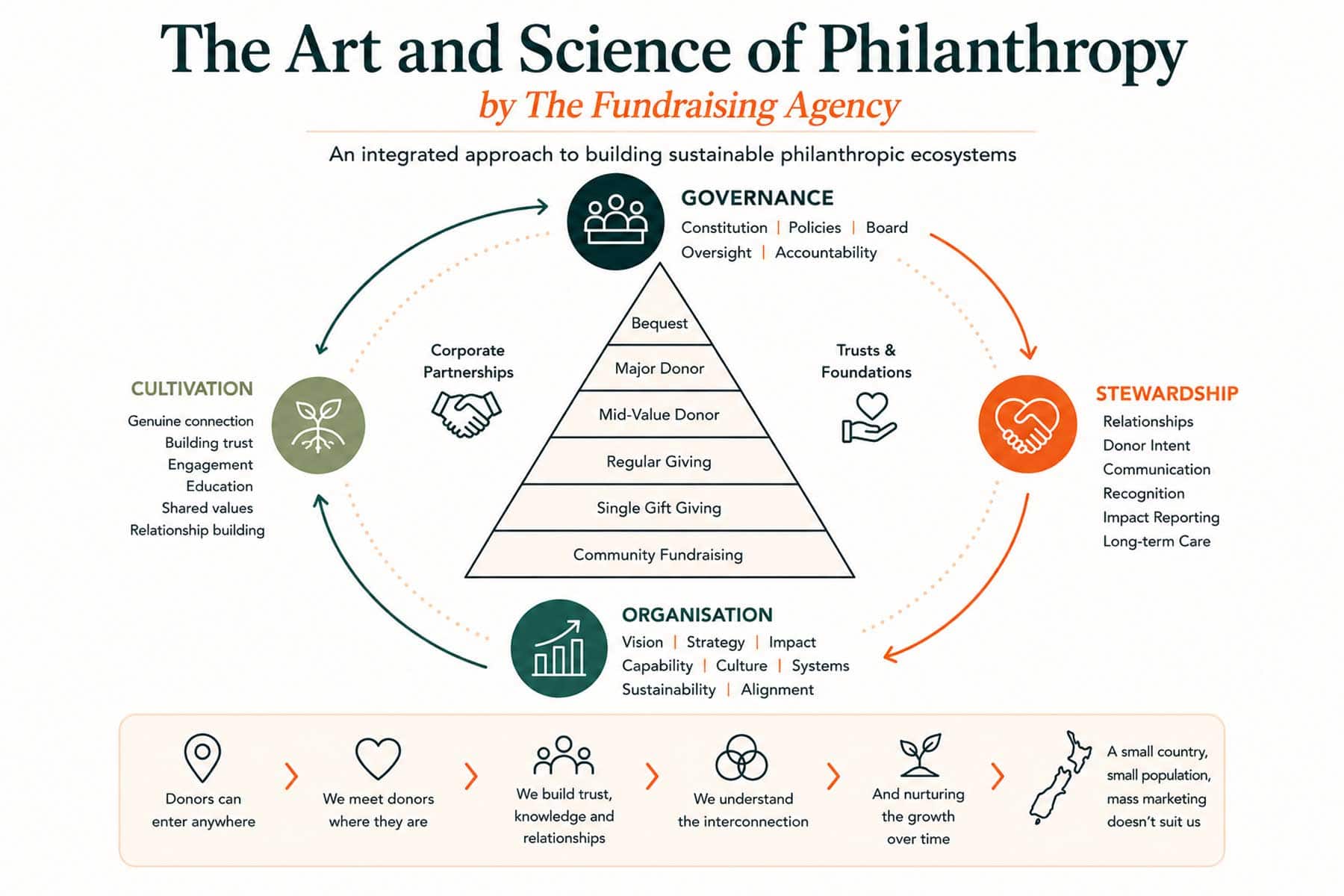
Embedding and activating a genuinely philanthropic culture is both an art and a science. As a ‘people-first’ approach, a philanthropic mindset requires us to discover what matters deeply to another person, and craft relationships of mutuality. These will not follow prescriptive steps, but use nuanced approaches which vary person to person, meeting each donor where they are at. Yet, to reinforce that your charity is the deserved holder of such long-term trust, and that you can and will shepherd investment into measurable impact, requires the application of strategies, structures, policies and processes that are rigorous, ethical and proven.
The thinking, attitudes and infrastructure that breathe life into philanthropic giving must extend throughout the entire organisation, and they prompt us to ask ourselves questions beyond how much money we need to balance the budget. They ask:
- Does this organisation know where it is going and what it wants to achieve?
- Are we committed to that vision for the long-term, beyond changes of governance, leadership or staff?
- Are we clearly and compellingly articulating that purpose in ways that donors can identify and connect with?
- Do we believe in our purpose at every level of our organisation, and do we all understand why we are here?
- Have we considered what our donors want and need from us, and what they want to leave as a legacy through their investment with us?
- How and who will hold and nurture these relationships over time?
- Do we have financial clarity, integrity and plans to demonstrate how we will steward gifts into outcomes?
- Does our track record and reputation speak to our future achievement?
Viewed in this light, it is obvious that true philanthropy is not simply fundraising, nor is it the remit of the fundraising department alone; rather, it is driven by leadership and must be embedded, lived and championed at all levels.
The gift of a philanthropic approach
A philanthropic culture encourages us to think beyond our immediate needs and conceive of what is possible. The shift from deficit – what we are lacking – to the abundance of a co-operative future changes the conversation completely. It enables people to envisage what their support could help this organisation, community, or cause to achieve over the next twenty years, and that is more inspirational and aspirational than “please support our annual appeal.”
That is why, at its best, philanthropy is transformational for everyone involved. The biggest gift of philanthropic giving is not monetary (although that will come) – it is the deep, lasting impression felt by a donor when they have become an integral part of something bigger than themselves. That is personal, and profound.
Keep up the fundraising activity, but don’t neglect to proactively build your philanthropic culture too. It’s mindful and deliberate work but, really, it’s just the activation of what you already know and fervently believe in – your charitable purpose, and the importance of your donors in achieving it. A wider opportunity awaits New Zealand charities who don’t just ask for help, but invite supporters to become part of a legacy built on realising possibilities.