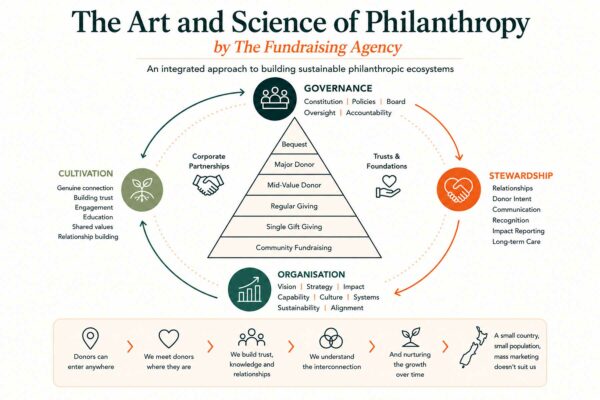
When you’re looking at how to raise those elusive dollars to power your purpose, there are seven main streams* you can tap into: Single Gift Giving, Regular Giving, Community Fundraising; Trusts and Foundations: Major Gifts; Corporate Partnerships; and Bequests.
Essential to successful fundraising is a good fundraising strategy built on an understanding of how to make the biggest financial impact for your organisation, and how to make the best use your – let’s be honest – limited resources. Because we at The Fundraising Agency understand each stream well, and have experience in activating them all, we know which ones might be the best for your charity at differing stages of your fundraising journey.
Exactly how much effort to put into different streams at different stages depends on several factors. What do you want to achieve as an NFP, and by when? How big or strong is your current support base? How mature is your existing fundraising? Is your core purpose one with mass appeal, or more likely to attract smaller numbers of higher-worth donors?
Each stream is likely to play some part in your fundraising future, but choosing the wrong stream, or the wrong time to try and activate it, can result in wasted time and energy, leaving your team feeling frustrated, disheartened, and maybe a little desperate.
That is where objective and external analysis and advice can help. When we create a three-year fundraising strategy for a charity, we draw on best practice, first-hand experience, and New Zealand insights and data to provide recommendations about the fundraising mix relevant to where you are now, and where you want to go. Your questions, answered.
Single Gift Giving
These gifts may be one-offs, recur sporadically, or be given in response to your direct asks.
Single gifts enable people to immediately express support without committing time, money or energy over the long-term. Existing supporters may give single gifts and acquisition campaigns are generally targeted at attracting new donors into single gift giving.
Single gifts are often the start of a donor giving journey and whether people give again has a lot to do with how you acknowledge them and create a relationship. If your do this thoughtfully, you can convert some of your single gift donors into regular givers (e.g. a committed monthly donation) through a planned stewardship process.
Regular Giving
Regular giving creates a more predictable income stream, which in turn provides stability and supports sustainability.
Regular giving is normally a gift made monthly, although different timeframes (e.g. fortnightly, three-monthly) can apply, based on the donor’s needs. Typically, you will identify potential regular givers from your single gift givers, and invite and encourage them to commit to regular giving, although a regular giving commitment may appeal to some new donors.
A successful regular giving plan will include ways to identify potential regular givers from your current supporters, online options to sign up to regular giving, and considered ways to thank, acknowledge and reward their commitment.
Community Fundraising
If your charitable purpose is one that resonates with external communities, or you have a large network or supporters and volunteers, community fundraising can contribute both funds and profile. Community fundraisers use their own initiative to raise funds on your behalf, drawing on their own networks, thus promoting your work and value at the same time. It also creates a pipeline for other types of giving in the future, including volunteering, single gift and regular giving.
Community fundraising can be led by donors (e.g. through quiz nights, sponsored participation in local events etc) and this requires a little investment from your fundraising team; perhaps a few basic resources, guidelines and identifying some key opportunities. It can also be led by the charity (e.g. Breast Cancer Pink Ribbon breakfasts, or the Bowel Cancer Move Your Butt walk); this requires more thought and set-up, but can also deliver increased profile and publicity for your charity.
Trusts & Foundations
Grants from Trusts and Foundations are often the cornerstone of many NFPs, especially those which haven’t yet built a strong network of supporters, or which need money (relatively) quickly.
Corporate Partnerships
Whilst some businesses and corporates offer charitable support connection via a donation, sponsorship of a programme, or even a contestable fund, corporate relationships can be so much more when they are considered and cultivated with purpose.
Corporate entities can primarily offer a charity money, goods or services in return for brand alignment, marketing exposure, staff engagement, tax incentives and genuine good will.
Ideally you will find partners amongst businesses you are already connected with and aligned to, but you can also create partnerships based on shared values and purpose.
Clear expectations and returns are essential to maximise and grow benefits of corporate partnership. The Fundraising Agency has the expertise to help you identify opportunities for corporate support and leverage these into a valuable fundraising stream. Find out more here.
Major Gifts
Major gift donors or High Net Worth Individuals (HNWI) are people who have a deep connection with your cause, and have the resources to make a significant contribution to your long-term vision. Exactly what that looks like in dollar terms may be different for different charities.
HNWI usually come from your existing supporter base, and they may or may not have given a significant gift previously.
To unlock the success of this stream it is imperative to ensure that your organisation is ready to not just accommodate major gifts, but to inspire and excite potential HNWI donors to give.
Identifying, engaging and supporting HNWI donors is an involved process which requires detailed prospecting, research (to establish their and implementation. The Fundraising Agency follows a ten-step approach which has led to successful major donor programmes for many charities.
Bequests
Bequests, also known as legacies or gifts in wills, are gifts given when a supporter includes your organisation in their will. Bequest fundraising therefore requires a different approach to other forms of fundraising, and needs to be managed with confidence, tact and diplomacy.
As gifts planned for an indeterminate time in the future, bequests are an investment in your organisation’s long-term mission; it is therefore important that you have a well-established reputation and financial stability that indicates you will be around long enough to receive a bequest.
Potential bequest donors are likely to be part of your existing support network, but they may not be significant financial donors. They are usually motivated by a simple desire to support the organisation, and/or to create a lasting memorial for themselves or a loved one.
Bequests may take a long time to come to fruition, but this stream is one worth engaging in, even in relatively passive ways. There is currently great opportunity for organisations to create or improve their bequest programmes because:
- The population is ageing, therefore there are more potential legacy donors. This is part of The Great Wealth Transfer (the transfer of significant wealth from the Baby Boomer generation into the next).
- Technology has made it easier for New Zealanders to make a will online.
- Changes to the Trusts Act 2019 have made it more difficult to maintain a family trust.
If you are interested in establishing a Bequest Progamme for your charity, reach out to The Fundraising Agency for support.
* Streams are not to be confused with actions – events, mailouts, online campaigns etc. Those are the tactics within your strategy and you might utilise one or many of these within multiple streams.